FD30 vs FD60 Fire Doors: Which Rating Do You Need?
Updated 12 June 2026|8 min read
FD30 fire doors hold back fire for 30 minutes; FD60 doors hold it back for 60. FD30S (with smoke seals) is the workhorse rating for most HMO bedroom and kitchen doors and many flat entrance doors, while FD60 is specified for higher-risk locations: plant rooms, doors between commercial and residential areas, and certain flat-entrance scenarios in taller buildings. Crucially, the rating belongs to the whole doorset, not just the leaf, and your fire risk assessment decides which applies where. This guide explains the difference and the cost.
What do FD30 and FD60 actually mean?
The number after FD is the minutes of fire integrity the door assembly provides under test conditions, and it is a measured performance figure rather than a loose grade.
An FD30 door resists the passage of fire for 30 minutes; an FD60 door resists it for 60. That integrity buys time for occupants to escape and for the fire service to arrive, by keeping a fire contained within the room or compartment where it started. Most residential fire doors also carry an S suffix, as in FD30S, meaning they include cold smoke seals; smoke kills before flame does, so smoke control is as important as fire integrity on escape routes.
Both ratings are tested to the same standards; the FD60 simply has to survive twice as long. In practice that means a denser, heavier core, a more robust frame and upgraded ironmongery. The rating is not something you choose for peace of mind or upgrade for the sake of it: under-specifying fails an inspection and risks lives, while over-specifying wastes money and hangs unnecessarily heavy doors that occupants prop open. The right answer comes from the fire strategy for your specific building.
Where is FD30 legally required?
FD30S is the default fire door across the great majority of London's residential fire strategies, and most doors we fit in HMOs and flat conversions are FD30S.
In a House in Multiple Occupation, government and council HMO standards typically call for FD30S doors to bedrooms, to the kitchen and to any door opening onto the protected escape route (the hallway and stairs that lead to the final exit). The principle is compartmentation: each room is sealed for 30 minutes so that a fire in one bedroom cannot fill the only escape route with smoke and flame while others get out.
Flat entrance doors, where a flat opens onto a common corridor or stair, are commonly specified to FD30S under current guidance for lower-rise buildings, often with the entrance door additionally needing to meet smoke-control requirements. The exact specification follows the building's fire risk assessment and, for flat entrance doors in particular, the height and design of the block.
The headline point for most London landlords and flat owners is simple: if a fire risk assessor or HMO officer has flagged your internal and entrance doors, FD30S is almost always the rating they mean, fitted as a complete certified doorset rather than a leaf alone.
Where is FD60 required instead?
FD60 is the higher-risk rating, specified where 30 minutes of protection is judged insufficient by the fire strategy, and it is the assessor's call rather than a default upgrade.
Typical FD60 locations include doors to plant rooms, boiler rooms and electrical intake cupboards, where the fire risk and fuel load are higher; doors separating a commercial unit from residential accommodation above, such as a shop or restaurant beneath flats, where a 60-minute separation protects the homes from a higher-risk use below; and certain flat entrance doors in taller residential buildings, where the fire strategy demands a longer period of protection to the common escape route. Doors onto basement areas and some larger or more complex HMOs can also fall into the FD60 category.
The common thread is that FD60 protects against a more severe or longer-developing fire, or shields a vulnerable escape route serving many people. Because the consequences of getting these wrong are serious, FD60 specifications are driven directly by the fire risk assessment, building control or a fire engineer, never by guesswork. Where an assessment specifies FD60, an FD30 door is not a saving; it is a non-compliance that an inspector will require you to put right.
FD30 vs FD60 compared
The table below summarises the practical differences. Treat the costs as fitted London ranges for a complete doorset in 2026, excluding VAT, and the uses as typical rather than a substitute for an assessment.
The pattern is consistent: FD60 costs more because the leaf is heavier and denser, the frame and ironmongery are upgraded, and the certification is more demanding. But cost should never drive the choice. The fire risk assessment specifies the rating for each opening, and the only correct door is the one it calls for.
Factor
FD30 / FD30S
FD60 / FD60S
Fire integrity
30 minutes
60 minutes
Typical use
HMO bedrooms, kitchens, escape-route doors, many flat entrance doors
Plant rooms, commercial-to-residential separation, taller-block flat entrances, some basements
Leaf weight
Standard fire-rated core
Heavier, denser core
Typical cost fitted
£400 – £900
£700 – £1,200
Specified by
Fire risk assessment / HMO standard
Fire risk assessment / fire engineer / building control
Why it is the doorset, not just the leaf
The single most misunderstood point about fire doors is that the rating belongs to the whole assembly, the doorset, and not to the door leaf on its own. A correctly rated leaf hung in the wrong frame, with the wrong gaps or missing seals, is not a fire door at any rating.
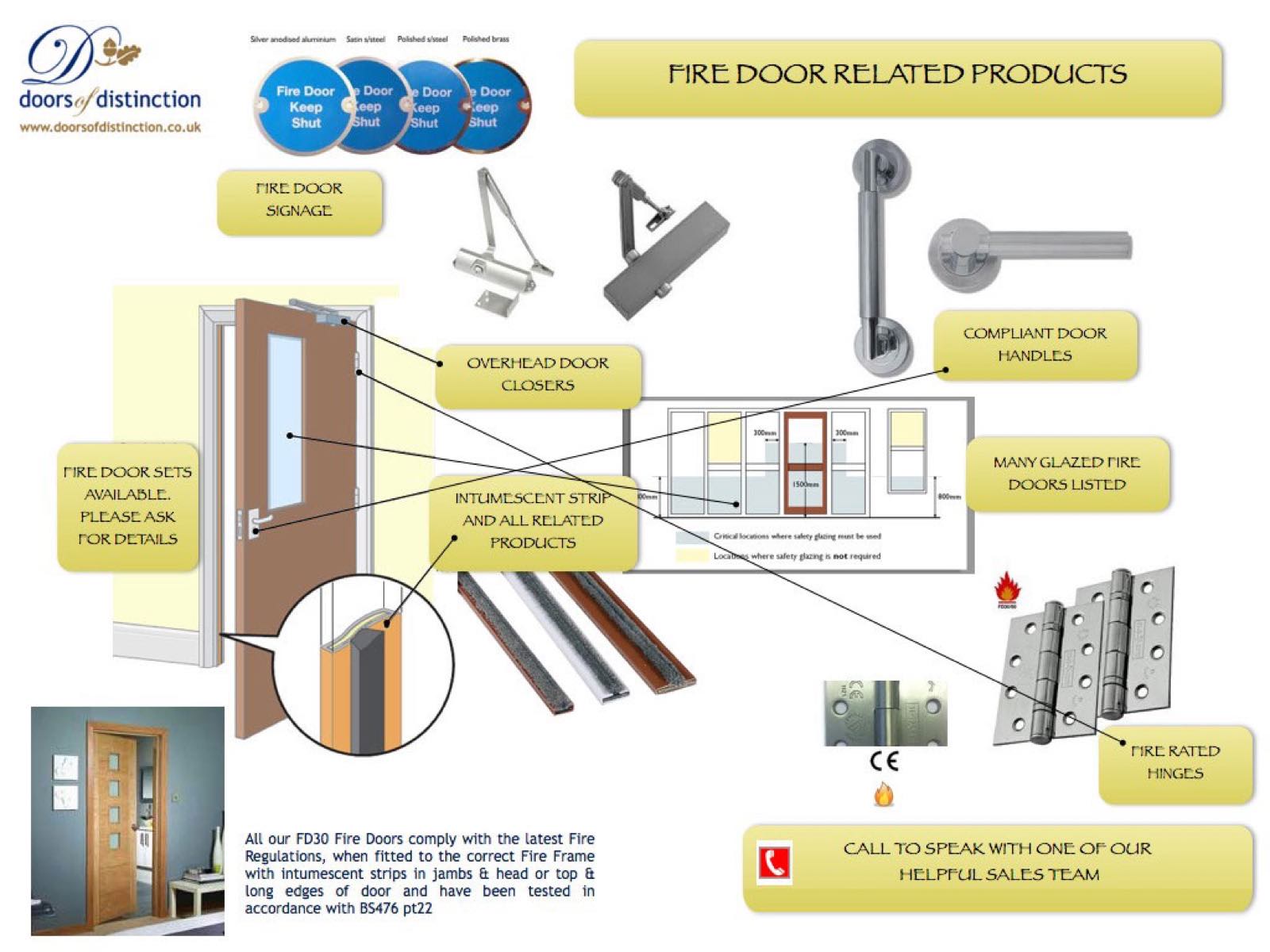
A compliant doorset is a tested combination: the leaf, the frame, the intumescent strips that expand in heat to seal the gap, the cold smoke seals, fire-rated hinges (three per door), a controlled self-closer and a latch that holds the door shut. Each part has to be compatible and fitted to the manufacturer's instructions, with a consistent gap of around 3mm around the leaf. Too tight and the door binds; too loose and smoke passes before the strips can act.
This is why an FD30 doorset and an FD60 doorset are priced and certified as complete units. It is also why we are called out to put right as many failed doors as we fit new ones: a door planed down to stop it sticking, a self-closer removed because it slammed, or non-fire-rated hinges fitted by a previous decorator will fail an inspection regardless of how good the leaf is. Certification and a paper trail of installation matter as much as the door itself.
How a fire risk assessment specifies the rating
You should not be choosing between FD30 and FD60 from a blog or a brochure; the rating for each door comes from a fire risk assessment of your specific building, and that is the document an inspector will hold you to.
For most residential premises and all HMOs, a fire risk assessment is a legal requirement, and it identifies every door that forms part of the fire strategy, what it protects and therefore what rating and features it needs. It will distinguish the FD30S bedroom doors from any FD60 plant-room or separation doors, and it will note where smoke seals, self-closers or vision panels are required. A good assessment turns a vague worry into a precise, costed schedule of doors.
When we survey fire doors across London, we work to that assessment rather than around it. For each opening we record whether the existing door can be upgraded or must be replaced, whether the frame and gaps are compliant, and which certified doorset matches the specified rating. That keeps you compliant without over-spending on a higher rating than the strategy requires. If you do not yet have an assessment, that is the first step, because everything else, including the FD30-versus-FD60 question, follows from it.
The cost difference and how to budget
Across London in 2026, a complete fitted FD30 doorset costs £400–£900, while an equivalent FD60 doorset costs £700–£1,200, both excluding VAT. Upgrading a suitable existing solid-timber door to FD30 standard, with new strips, seals, fire-rated hinges and a self-closer, costs £150–£350, but FD60 is rarely achievable by upgrade and usually means a new doorset.
For landlords, fire doors are seldom a single purchase. A four-to-six-bedroom HMO fire door package commonly lands at £2,500–£6,000, depending on how many doors can be upgraded versus replaced and whether any FD60 doors are in the schedule. A property with sound solid-timber doors sits at the lower end; one with hollow-core doors throughout, or one needing FD60 separation, sits higher.
The sensible way to budget is to start from the fire risk assessment, get a door-by-door survey that states upgrade or replace and FD30 or FD60 for each, and then price the package as a whole. That avoids both the false economy of an under-rated door, which simply comes back as a failed inspection and a second visit, and the waste of an over-rated one. Our fire door work dovetails with alarms, emergency lighting and the wider fire-safety compliance package landlords need for licensing.
Frequently Asked Questions
What is the difference between FD30 and FD60 fire doors?
An FD30 door resists fire for 30 minutes; an FD60 door resists it for 60 minutes. FD60 doors have a heavier, denser core, upgraded frames and ironmongery, and cost more. FD30S is the standard for most HMO and flat residential doors, while FD60 is reserved for higher-risk locations specified by a fire risk assessment.
Which fire door rating do I need for my HMO?
Most HMOs require FD30S doors to bedrooms, kitchens and any door onto the protected escape route, with flat entrance doors commonly FD30S in lower-rise buildings. FD60 is only needed where the fire risk assessment specifies it, such as plant rooms or commercial-to-residential separation. Your fire risk assessment is the document that decides each door, not a default rule.
Is an FD30 fire door enough for a flat entrance?
In many lower-rise buildings, current guidance specifies FD30S for flat entrance doors, often with additional smoke-control requirements. In taller blocks, or where the fire strategy demands longer protection to the common escape route, FD60 may be specified. The correct rating depends on the building's height and design and is confirmed by the fire risk assessment.
How much more does an FD60 door cost than an FD30?
A complete fitted FD60 doorset costs £700–£1,200 in London in 2026, against £400–£900 for an equivalent FD30, both excluding VAT. The premium reflects the heavier leaf, upgraded frame and ironmongery and more demanding certification. Cost should never drive the choice; the fire risk assessment specifies the rating for each opening.
Why does the whole doorset matter, not just the door leaf?
A fire door only achieves its rating as a complete tested assembly: leaf, frame, intumescent strips, smoke seals, fire-rated hinges, self-closer and latch, all fitted with the correct gaps. A rated leaf in the wrong frame, with worn seals or a missing closer, is not a fire door at any rating, which is why FD30 and FD60 are certified and priced as full doorsets.