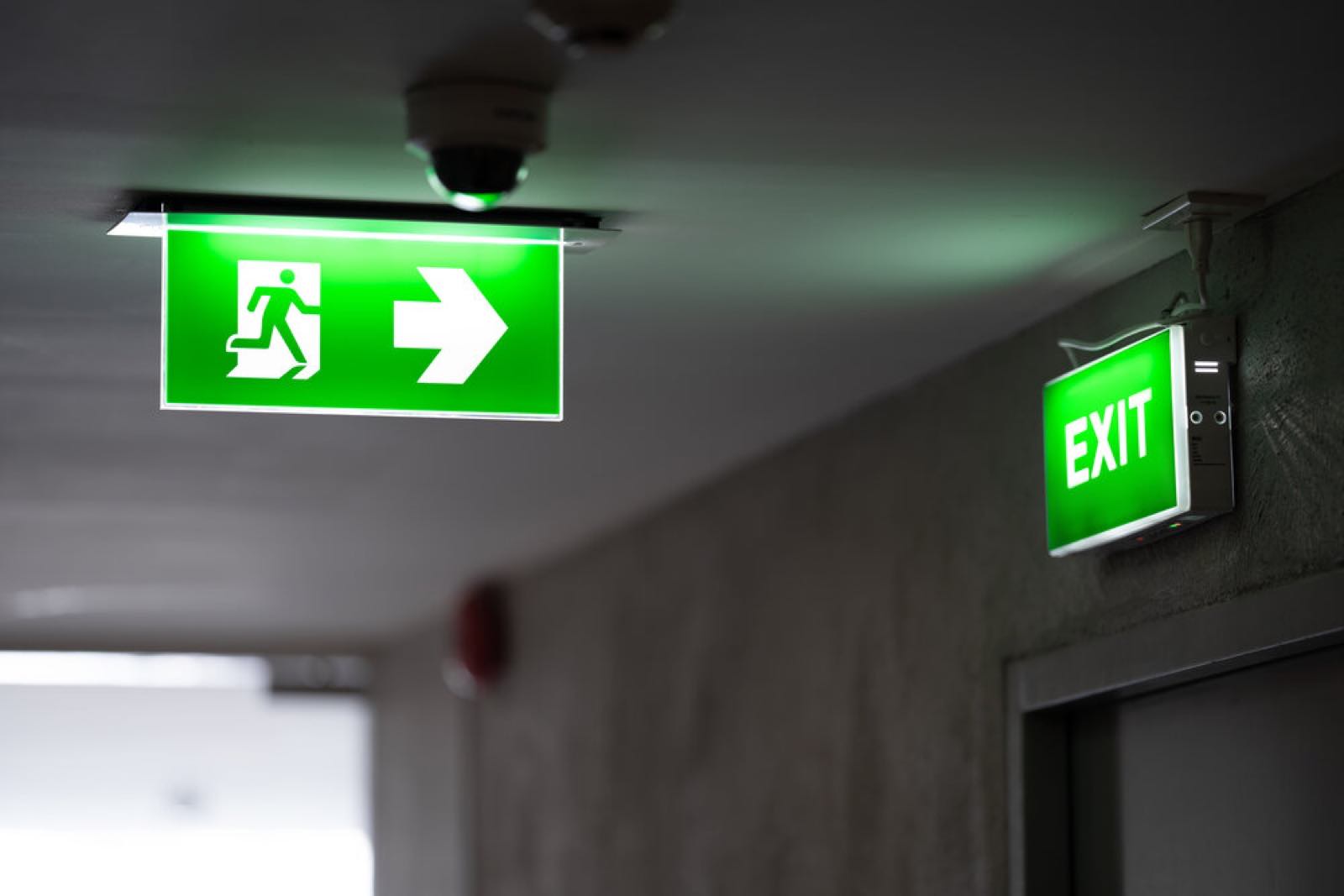
We design, install and certificate emergency lighting to BS 5266-1 across London HMOs, converted blocks and communal areas — one accountable contractor for landlords, letting agents and freeholders. Escape routes stay lit for three hours on mains failure, every system is designed around your fire risk assessment, and the certification arrives in the format borough licensing officers actually ask for.
Written Guarantee: 5 Years
|
Average Timeline Range: 1 - 3 days
Why London HMOs and Blocks Need Emergency Lighting
When the power fails in a single household, finding the stairs in the dark is an inconvenience. In a five-storey Victorian conversion in Hackney or a mansion block off the Finchley Road, it is exactly the scenario in which people fall or freeze on an escape route — which is why fire risk assessments and borough HMO licensing conditions routinely require emergency escape lighting in larger or higher-risk properties.
BS 5266-1 is the design standard, and it is prescriptive for good reason. Luminaires must sit at every change of direction and change of level, at each storey landing, near fire alarm call points and fire-fighting equipment, and outside every final exit. In London's period stock — long communal halls, half-landings, basement flats with a single stair to the street — those points multiply quickly, and a system designed to the standard looks very different from bulkheads scattered by eye.
We design around your fire risk assessment rather than a generic template, because a two-storey house share in Ealing and a purpose-converted block in Camden are judged against different licensing standards. The difference is a system that passes inspection first time versus one that merely exists and then fails a re-visit.
Maintained, Non-Maintained and the Three-Hour Rule
Non-maintained luminaires stay dark in normal conditions and light only when the mains supply fails — the usual, battery-friendly choice for HMO stairways and corridors that already have working general lighting. Maintained luminaires run continuously and double as normal lighting, used where light is wanted at all times, in windowless internal lobbies, or where a borough's licence conditions specifically call for it. Combined fittings and illuminated ‘running man’ exit signs do both jobs in a single unit above a final exit door.
The benchmark duration is three hours. Batteries must hold escape routes lit long enough for full evacuation and for the London Fire Brigade to work the building, so we specify LED luminaires with three-hour rated batteries as standard.
Design is not just about where fittings go but how much light they throw. BS 5266-1 sets minimum illuminance along the centre line of each escape route, with higher levels at ‘points of emphasis’ — stairs, changes of level and fire equipment. We size and space luminaires to hit those figures rather than guessing coverage, which matters in a long Georgian hallway where one under-specified fitting leaves a dark patch exactly where the stair turns.
Testing, Records and Licensing Certification
Emergency lighting is only compliant while it is tested, and this is where most London landlords come unstuck. BS 5266-1, with BS EN 50172, expects a brief monthly function test — the ‘flick test’, switching each luminaire to battery and confirming it lights — and an annual full-duration test, running the whole system on battery for its full three hours and verifying every fitting lasts the distance. The results live in a log book that licensing officers and fire risk assessors ask to see on the day.
We install key switches so the monthly test is a one-person, thirty-second job rather than a reason to pull the main fuse and plunge a tenanted HMO into darkness. We hand over the log book started, complete the initial commissioning certificate, and format the paperwork for council licensing files in Newham, Brent, Southwark or wherever the property sits.
For letting agents and block managers who would rather not chase the regime, we run scheduled testing visits with a dated, photographic report each round. Every installation is certificated by our qualified electricians and wired to BS 7671, so the emergency lighting file and the electrical file agree with each other.
How to Choose the Right Emergency Lighting Contractor in London
Emergency lighting sits at the intersection of electrical work and fire safety, so the contractor has to be credible on both. Use these criteria before you commit.
Insist on a design, not a shopping list. A serious firm plots luminaire positions against your fire risk assessment and BS 5266-1 before quoting; anyone who prices ‘six bulkheads’ over the phone without seeing the escape route is guessing. Check electrical competence: the installation must be carried out and certificated by qualified electricians to BS 7671, because a fitting that is wired badly is worse than no fitting at all.
Confirm the deliverables in writing. You want a fixed written quote, an initial completion certificate, a commissioning record and a started log book — not a verbal assurance. Ask how testing is handled afterwards; a contractor who fits key switches and offers a scheduled monthly and annual regime understands that installation is only the start of compliance.
Check cover and accountability. Ask for proof of £5m public liability insurance. Finally, favour a single accountable contractor who can also handle the fire doors, interlinked alarms and any remedial electrics the same assessment throws up — chasing three separate trades across a licensed HMO is how deadlines and licence conditions slip.
Installing in Occupied HMOs, Period Stock and Conservation Areas
Most emergency lighting goes into properties that are already tenanted, decorated and lived in, which shapes how the work is done. In an occupied HMO we plan cable routes to avoid chasing through freshly painted communal walls where possible, using surface trunking, existing lighting circuits and self-contained fittings that take local mains power rather than a long run back to a central battery.
London's building fabric adds its own complications. Solid Victorian and Edwardian walls, lath-and-plaster ceilings and the tight winding stairs of a terrace conversion all affect fixing and cable routes, and we survey for them rather than discovering them mid-job. In leasehold flats and blocks, communal emergency lighting is usually the freeholder's or managing agent's responsibility, and altering communal wiring can require a licence to alter — we flag that before starting so nobody breaches their lease.
Access and parking are real costs in inner London. We factor loading, permits and restricted parking in boroughs like Kensington and Chelsea or Islington into the quote up front. Where a property sits in a conservation area, external emergency fittings above communal entrances are chosen and positioned sympathetically, and any work affecting a shared wall is checked against party wall obligations before we touch it.
Where Emergency Lighting Fits Into HMO and Block Compliance
Emergency lighting rarely arrives on its own. It is usually one line on a fire risk assessment that also calls for FD30 or FD60 fire doors, an interlinked BS 5839-6 alarm system and sound compartmentation — and the licence is only granted when the whole package is signed off.
Because we work as a single accountable contractor, we can install the emergency lighting alongside the fire doors and alarms in one coordinated programme rather than sending you to three firms who each blame the others when the inspector finds a gap. That matters for sequencing: there is no point certificating escape lighting on a stair whose fire doors are about to be swapped, disturbing the fittings and the fresh decoration around them.
For letting agents managing portfolios across several boroughs, we standardise the documentation so every property's emergency lighting certificate, log book and test schedule follow the same format — far easier to file and produce at a licensing renewal or a selective licensing inspection. And because the same team handles the associated electrics, the emergency lighting circuit, the alarm supply and the general lighting all appear correctly on the electrical installation certificate, so the paperwork tells one consistent story to the council.
Timeline, Guarantee and What a Typical Job Looks Like
A typical emergency lighting installation runs one to three days on site, depending on the size of the property and how much cable has to be routed through finished communal areas. A four-to-eight-fitting three-storey HMO is usually a one-day job; a larger converted block with multiple lobbies, landings and final exits takes two to three.
The sequence is straightforward. We survey against the fire risk assessment and confirm the luminaire schedule, then issue a fixed written quote — no starting work and ‘finding more’ later. On site, fittings are positioned to BS 5266-1, wired and certificated to BS 7671 by our qualified electricians, and the system is commissioned with a full three-hour discharge test to prove every luminaire holds. We fit the test key switch, start and hand over the log book, and issue the completion certificate formatted for your borough's licensing file.
Every installation carries our five-year workmanship guarantee, and we can pick up the ongoing monthly and annual testing so the system stays compliant rather than lapsing the moment the paperwork is filed. If a battery or driver fails a discharge test within the guarantee, we return and put it right — the point of a system that has to work on the one night the power goes out.
What Emergency Lighting Installation Costs in London (2026)
Item
Typical London Price
Notes
Non-maintained LED luminaire (bulkhead), fitted
£120–£200 per unit
Escape-route light lit only on mains failure; standard for HMO corridors and stairways.
Maintained luminaire or illuminated exit sign, fitted
£150–£250 per unit
Runs continuously; used where light is wanted at all times or licence conditions specify it.
Typical three-storey HMO system (4–8 fittings), certificated
£600–£1,800 per property
Includes test key switch, log book and initial BS 5266-1 certificate.
Converted block / larger HMO (10–20 fittings)
£1,800–£4,500 per property
Multiple landings, lobbies and final exits; priced per schedule after survey.
Test key switch and log book supply
£45–£120 per system
Makes the monthly flick test a one-person job and satisfies inspectors.
Annual full three-hour discharge test & certificate
£90–£250 per visit
Depends on fitting count and site; scheduled for agents and block managers.
Emergency lighting design to fire risk assessment
£150–£400 per property
Luminaire positions plotted to the standard rather than guessed by eye.
Additional call-out for remedial / failed-fitting swap
£90–£180 per visit
Battery or driver replacement on an existing fitting after a discharge failure.
Prices are typical Greater London 2026 ranges for supply, installation and initial certification; every job is confirmed with a fixed written quote after a site survey.
Insider Tips Before You Commit
Get your fire risk assessment done first — it dictates coverage, so installing before it means paying twice when the assessor asks for more fittings.
Insist on a test key switch on every system; without one, the monthly function test needs the main fuse pulled, which no busy agent will actually do.
Ask for the log book to be started on handover — an untested system is treated as non-compliant, and inspectors want to see the first entries dated.
Choose non-maintained fittings for stairways and corridors to save battery wear, and reserve maintained fittings for spots that genuinely need permanent light.
Specify LED luminaires with a self-test or addressable function on larger blocks — they log their own monthly checks and flag a failed battery before an inspection does.
Photograph luminaire positions against the FRA plan so a new managing agent inherits proof the layout matches the standard.
Book the annual three-hour discharge test in a low-occupancy window; running batteries flat mid-evening in a full HMO is asking for complaints.
In leasehold blocks, check the freeholder or managing agent's remit before commissioning — communal emergency lighting is often their duty, not the flat owner's.
How Not to Get Scammed
London has more rogue traders than any other UK market. These are the warning signs we see most often — and exactly what to do when you spot them.
Bulkheads screwed up at random with no design or FRA reference, then billed as a ‘compliant system’.
Ask to see the luminaire positions plotted against your fire risk assessment and BS 5266-1 before any fitting goes up; positions at changes of level, landings and final exits are not optional.
No initial certificate or log book handed over, just a verbal ‘it’s all done’.
Withhold final payment until you receive the BS 5266-1 completion certificate, the commissioning record and a started log book — the documents licensing officers ask for.
Cash-only, no VAT invoice and a large deposit demanded before any materials arrive.
Pay a modest deposit against a written quote from a VAT-registered contractor, and keep the invoice; a proper firm bills on stages, not a big cash lump up front.
‘We found more problems’ mid-job — extra fittings and rewiring added without a revised written quote.
Require any variation in writing with its own price before work continues; a survey-first contractor should have priced the schedule accurately from the start.
Ordinary maintained downlights sold as 'emergency lighting' with no three-hour battery.
Confirm every fitting is a rated emergency luminaire with a three-hour battery and check the product data sheet; standard LED fittings do nothing when the mains fails.
Uninsured labourer doing the electrical work with no proof they can certificate the wiring to BS 7671.
Ask for proof the electrician can self-certify to BS 7671 and holds £5m public liability cover before work starts; unqualified wiring voids compliance and invalidates the certificate.
Standards & Compliance
Every project is delivered to current British Standards and Building Regulations, with works documented for building control and HMO licensing sign-off — backed by fixed written quotes and a written guarantee.
BRITISH STANDARDS · BUILDING REGS COMPLIANT · FD30/FD60 FIRE DOORSETS · BS 5839-6 ALARMS · WRITTEN GUARANTEE
Frequently Asked Questions (FAQ)
Does my HMO need emergency lighting?
It depends on size, layout and risk. London boroughs commonly require emergency escape lighting in HMOs of three or more storeys, in larger HMOs, and wherever the escape route has no reliable borrowed light from windows or street lighting. Your fire risk assessment and the borough's licensing standards are the deciding documents. We review both and confirm exactly what is needed before quoting.
How much does emergency lighting installation cost in London?
Typically £120–£250 per luminaire installed and certificated, depending on wiring routes and access. A typical three-storey London HMO needs four to eight fittings, so complete systems usually land between £600 and £1,800 including the test key switch, log book and initial certification. Larger converted blocks with ten to twenty fittings run £1,800–£4,500. We give a fixed written quote after a survey.
What testing does emergency lighting legally need?
BS 5266-1 and BS EN 50172 set the regime: a monthly function test of every luminaire — the flick test — and an annual full three-hour discharge test, both recorded in a log book. Licensing officers and fire risk assessors ask for that log, and an untested system is treated as a non-compliant one. We fit key switches to make monthly testing simple and offer scheduled testing for landlords and agents.
Maintained or non-maintained — which do I need?
Non-maintained fittings, lit only on mains failure, suit most HMO escape routes and save battery wear. Maintained fittings, lit at all times, are used where the luminaire doubles as normal lighting, in windowless internal lobbies, or where licensing conditions specify them — some boroughs require maintained operation on certain stairways. We specify per the BS 5266-1 design and your licence conditions rather than by habit.
How long does installation take?
Most jobs run one to three days. A four-to-eight-fitting three-storey HMO is usually completed in a single day, while a larger converted block with multiple landings, lobbies and final exits takes two to three days, mainly because of cable routing through finished communal areas. We confirm the timeline in the written quote after surveying the property.
Can you install emergency lighting in an occupied, decorated HMO?
Yes, and most of our work is exactly that. We plan cable routes to avoid chasing through freshly painted communal walls where possible, using surface trunking, existing lighting circuits and self-contained fittings that take local mains power. Where routes must cross finished surfaces we agree the making-good beforehand, so tenants and the decoration are disturbed as little as possible.
Who is responsible for emergency lighting in a leasehold block?
Communal emergency lighting is normally the freeholder's or managing agent's responsibility, since it protects the shared escape route, whereas individual flats rarely need it. Altering communal wiring can also require a licence to alter under the lease. We flag responsibility and any licence-to-alter obligation before starting, so nobody commissions work they cannot authorise or breaches their lease.
Do you provide the certificate and log book councils ask for?
Yes. Every installation is certificated by our qualified electricians to BS 5266-1 and wired to BS 7671. We hand over the completion certificate, the commissioning record and a log book started with the first test entries, all formatted for your borough's HMO licensing file. We keep documentation consistent across portfolios so agents can produce it at a licensing renewal without hunting.
Will emergency lighting work with our other fire safety upgrades?
It should be planned together. Emergency lighting usually sits on the same fire risk assessment as FD30/FD60 fire doors and an interlinked BS 5839-6 alarm system. As a single accountable contractor we coordinate all of it in one programme, so escape lighting is not certificated on a stair whose fire doors are about to be swapped, and every circuit appears correctly on the electrical certificate.
What guarantee do you offer on emergency lighting?
All installations carry our five-year workmanship guarantee. If a fitting, battery or driver fails a discharge test within that period we return and put it right. We can also run the ongoing monthly and annual testing so the system stays compliant rather than lapsing once the paperwork is filed — the whole point of lighting that has to work on the night the mains fails.
Our Written Guarantee
We provide a fully comprehensive, written 5-Year guarantee covering all structural reinstatement, moisture boundaries, and finish coatings.
100% Insurance Protected
Request an Elite Assessment
Secure a rapid, high-precision physical survey by our team. Fill out our briefing engine instantly.
Emergency Lighting Installation Across Greater London
We deliver emergency lighting installation across all 33 London boroughs — from the City and Central London out to the M25. Tap any marker to see coverage and local postcodes.