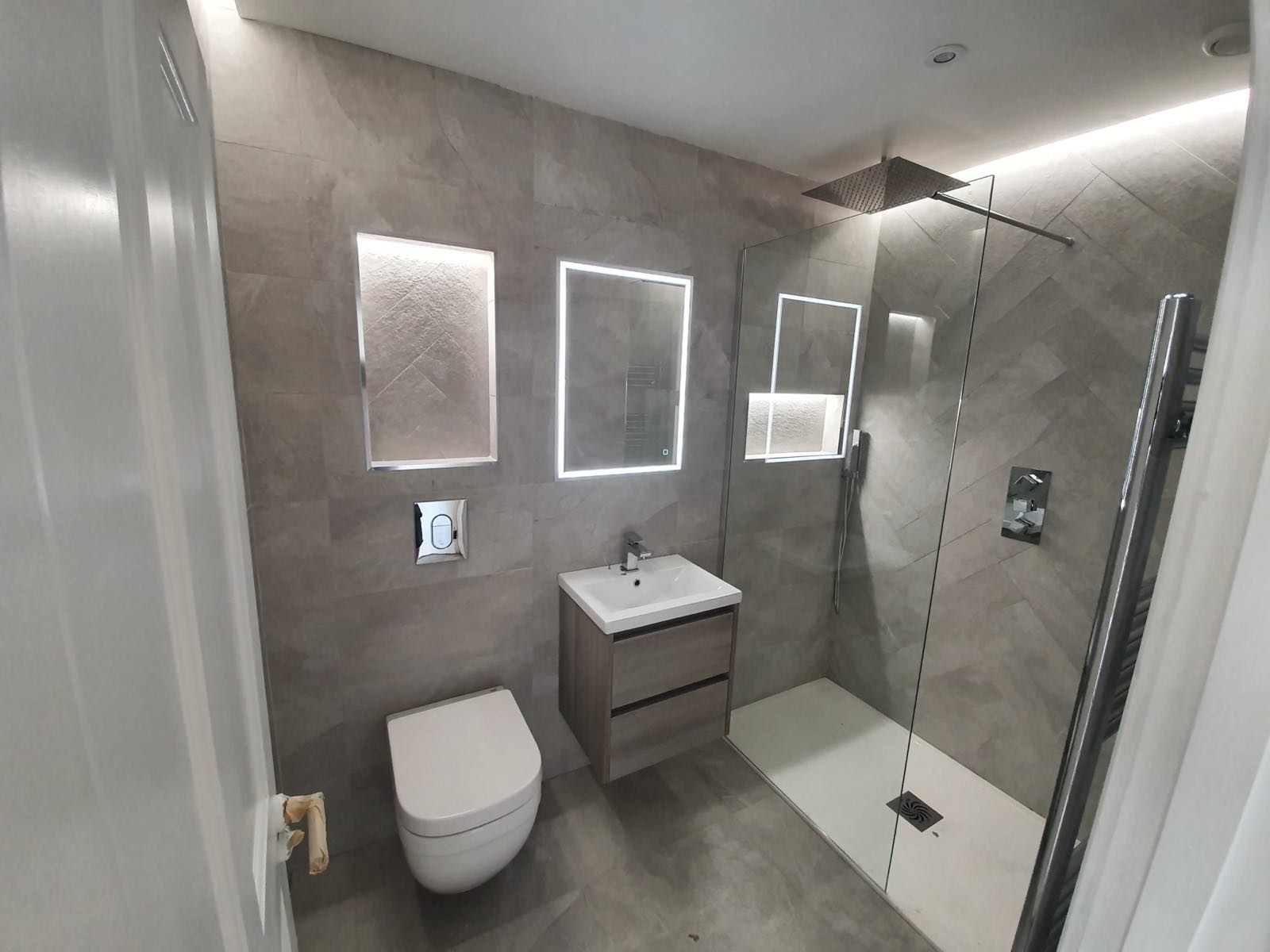
From brand-new bathroom installations and en-suites to full refurbishments, we build London bathrooms, shower rooms and wet rooms that are properly tanked, correctly ventilated and beautifully tiled. Plumbing, electrics, waterproofing, tiling and decoration are handled by one accountable contractor — the single point of contact landlords, letting agents and homeowners want — and every installation carries a 10-year waterproofing guarantee.
Written Guarantee: 10 Years
|
Average Timeline Range: 2 - 4 weeks
Waterproofing Before Beauty
Most bathroom failures we are called to repair were built in at installation: no tanking behind the shower, movement-prone boards tiled without decoupling, silicone asked to do a job a membrane should have done. In a London flat the damage rarely stays put — it appears two floors down in someone else’s ceiling, and in a mansion block or conversion that quickly becomes a liability claim between leaseholders.
Every bathroom we build is waterproof first. Wet zones are tanked with a full membrane system, wet rooms receive formed falls and tested trays, and pipe penetrations are sealed with proprietary gaskets rather than mastic and hope. We pressure-test pipework before anything is closed up and photograph each stage, so you can see exactly what is behind your tiles rather than taking it on trust.
This is why we can offer a 10-year guarantee on waterproofing — and, candidly, why a meaningful share of our work is rebuilding bathrooms other contractors finished only eighteen months earlier. Tanking adds a modest cost at build stage; skipping it is the single most expensive false economy in the trade.
Design and Specification That Suit the Building
A bathroom in a Victorian terrace in Wandsworth is a different engineering problem from one in a 1930s mansion block in Maida Vale or an ex-local-authority flat in a concrete-floored slab. Joist direction dictates where waste runs can go, mains and tank pressure determine whether a mixer or pumped shower is realistic, and floor build-up height decides whether a level-access wet room is even possible. We survey all of this before anyone talks about tiles, then design around the building rather than selling you a brochure photo it cannot deliver.
Our specification covers sanitaryware, brassware, tiles, stone, lighting, heated towel rails and underfloor heating, with alternatives at different price points on each line so you can see where money is well spent and where it is vanity. We supply through trade accounts at better-than-showroom prices, or fit client-supplied items from the likes of C.P. Hart, West One or Bathstore-equivalents happily — we check deliveries are complete before strip-out so the programme is never hostage to a missing vanity unit.
Proper extraction, demisting mirrors and electric underfloor heating are specified as standard on most projects. They are small costs at first fix and expensive, disruptive regrets once the tiling is done.
How to Choose the Right Bathroom Contractor in London
The gap between a good and a bad London bathroom is almost entirely hidden behind the tiles, so choose on the things you can’t see rather than the showroom render. Ask five concrete questions and judge the answers.
First: what waterproofing system goes behind the wet zones, and will you photograph it before tiling? A confident fitter names a membrane and offers the photos unprompted. Second: are the electrics certified to BS 7671 with a Part P notification? You need that certificate for landlord compliance, insurance and resale. Third: is the quote fixed and itemised, or a vague lump sum? Itemised quotes are far harder to inflate mid-job. Fourth: what public liability cover do you carry? In a flat above other homes, £5m is the reassurance you want, and we carry it. Fifth: who actually does the tiling, plumbing and electrics — one accountable team, or a chain of subcontractors who will blame each other when something fails?
For leasehold flats, add a sixth: has the contractor dealt with freeholder licence-to-alter and managing-agent requirements before? Moving a soil stack or forming a wet room usually needs written consent and acoustic sign-off, and a contractor who has never navigated it will stall your job. Cheapest is rarely the answer — labour is roughly half the cost of a bathroom, so a suspiciously low quote is corners cut precisely where you can’t inspect them.
Wet Rooms and En-Suites in London Flats
Wet rooms are the request we field most from Central and inner-London clients, and the honest answer is always "subject to the floor". A true level-access wet room needs depth to form the falls to the drain and to bury a tanked tray — straightforward over timber joists in a Victorian conversion, harder over the shallow concrete floors common in ex-LA blocks and post-war flats, where a slight upstand or a low-profile former is the sensible compromise. We confirm what’s achievable at survey rather than promising a level threshold the slab won’t give.
En-suites carve a second bathroom out of a bedroom corner, a landing or eaves space, and here the constraint is drainage, not floor area: gravity waste needs a fall back to the stack, and where that isn’t possible a macerator or pumped system does the job, sized properly and vented. Sound matters too — in a mansion block or conversion, a new en-suite over a neighbour’s living room needs acoustic isolation to keep the peace and satisfy the lease.
In leasehold buildings a new wet room or en-suite generally requires freeholder consent and acoustic compliance under the lease. We prepare the drawings and specification managing agents ask for and handle the licence-to-alter process, so the paperwork moves in parallel with the build rather than holding it up.
Bathrooms for Landlords, Letting Agents and HMOs
A rental bathroom has a different brief from an owner’s: it has to survive turnover, clean fast at check-out and never generate a mid-tenancy disrepair call. We specify for durability — rimless back-to-wall WCs, wall-hung vanities that leave the floor clear, hard-wearing large-format porcelain with minimal grout, and brassware with readily available spares rather than a discontinued designer line no plumber can service in three years.
Compliance is built in, because it’s what protects the landlord. Electrics are certified to BS 7671, extraction meets Building Regulations Part F to keep condensation and mould out of the deposit dispute, and where a bathroom sits within a licensed HMO we work to the fire-separation and, where relevant, FD30 doorset requirements the licence imposes. For portfolio clients we sequence works around void periods so a bathroom refit lands inside the turnaround rather than extending it — every empty week costs real rent.
As one accountable contractor we also mean one point of contact for your negotiators: jobs raised by email or works-order, tenants contacted directly to arrange access, and completion evidenced with dated before-and-after photographs against the order number. Your office stops being the relay between tenant and trade.
Access, Programme and Living Through the Works
The part of a London bathroom job people underestimate is logistics, not the tiling. In controlled-parking boroughs — Kensington and Chelsea, Camden, Islington, Hackney and much of Zone 2 — deliveries, skips and waste removal need a parking suspension or visitor permits arranged before day one, and mansion blocks often restrict works to weekday hours with goods routed through a service lift and porter. We handle these bookings and brief the building manager so the job doesn’t stall on a technicality in week one.
Inside the flat, we protect the route in: floor coverings, corner guards and dust screens on the landing, because a scratched communal stair or a dusty lift lobby is how you lose a service charge argument. Waste leaves daily rather than piling up on the pavement, and we agree working hours that keep neighbours and managing agents onside.
A standard bathroom takes two to three weeks on site; wet rooms and bathrooms needing structural alterations run three to four. If it is your only bathroom, we sequence the work so a usable WC and a working shower are restored as early as possible, and we tell you honestly at survey which days will be the disruptive ones so you can plan around them.
What London Bathrooms Cost in 2026
A complete bathroom refurbishment in London — strip-out, first-fix plumbing and electrics, tanking, tiling, sanitaryware, decoration and certification — typically costs £8,000 to £25,000 at 2026 prices. The lower end covers a compact bathroom with quality trade fittings; the upper end a large bathroom or level-access wet room with premium brassware, porcelain or natural stone and underfloor heating. Genuinely top-end Central London bathrooms with book-matched stone run beyond £30,000. An en-suite or cloakroom, being smaller, usually sits between £5,500 and £12,000.
Labour and installation are roughly half the cost, which is exactly why a cheap quote almost always means corners cut in the places you can’t inspect — the tanking, the decoupling, the certified electrics. Within a full property refurbishment, the bathrooms and kitchen together typically absorb 30–40 per cent of the overall budget.
We quote fixed, itemised prices after a free survey, so you can see what each line costs and where you could trade down without compromising the waterproofing. Sanitaryware and brassware carry their manufacturers’ warranties on top of our 10-year guarantee on the waterproofing and installation workmanship.
What Bathroom Installation & Refurbishment Costs in London (2026)
Item
Typical London Price
Notes
Complete bathroom refurbishment
£8,000 – £25,000 per bathroom
Strip-out, first fix, tanking, tiling, sanitaryware, decoration and certification
En-suite / cloakroom install
£5,500 – £12,000 per room
Compact footprints; loft and under-stairs conversions cost more for waste runs
Level-access wet room
£9,000 – £22,000 per room
Formed falls, tanked tray and decoupling; depends on floor build-up
Wall & floor tiling (labour)
£70 – £130 per m²
Porcelain and ceramic; natural stone, mosaic and large-format add labour
Full tanking / waterproof membrane
£40 – £75 per m²
Liquid or matting system to wet zones before tiling
Electric underfloor heating
£600 – £1,400 per room
Mat, insulation boards, thermostat and RCD-protected connection
Certified electrics (Part P)
£450 – £1,200 per bathroom
IP-rated zones, extractor, lighting and BS 7671 certificate
Day-rate remedial / snagging
£280 – £360 per day
Two-operative team for small works, leaks or defect rectification
Guide prices for Greater London in 2026. We quote fixed, itemised prices after a free survey; supply of premium stone, imported brassware or structural alterations sits above these ranges.
Insider Tips Before You Commit
Insist on a tanked membrane behind every shower and bath, not just silicone — it is the single cheapest insurance against a leak reaching the flat below.
Order all sanitaryware and tiles before strip-out begins so a back-ordered vanity unit can’t freeze a two-week programme in a live building.
In a leasehold flat, apply for the freeholder’s licence to alter early — moving a soil stack or waterproofing a new wet room often needs written consent and acoustic sign-off.
Specify an extractor sized to the room’s air changes and vented to outside, never into a loft void, or you will trade a leak for black mould within a year.
Choose a rimless back-to-wall WC and wall-hung vanity for rental bathrooms — they are faster to clean at check-out and survive tenant wear far better.
Ask to see dated photographs of the pipework and membrane before tiling closes it in; a contractor confident in their first fix will offer them unprompted.
Keep large-format porcelain to floors and feature walls only — grout lines are where cheap tiling shows, and fewer joints means a cleaner, more lettable finish.
Book a single parking suspension or visitor permit for the skip and deliveries in controlled-parking boroughs before day one, not mid-programme.
How Not to Get Scammed
London has more rogue traders than any other UK market. These are the warning signs we see most often — and exactly what to do when you spot them.
Cash-only price with no written quotation or VAT invoice.
Only proceed on a fixed, itemised written quote and pay by traceable method; a legitimate contractor issues proper invoices and stands behind a written guarantee.
Large upfront deposit demanded before any materials are ordered or a survey is done.
Tie payments to stages — small mobilisation, then on completed first fix, tiling and sign-off — and never fund the whole job before work starts.
"We found more problems" mid-job with pressure to pay extra cash immediately.
Require any variation in writing with a price before it proceeds, and ask for photographic evidence of the alleged defect; genuine extras are documented, not sprung under pressure.
No mention of tanking, and tiling starts straight onto old plaster or chipboard.
Ask specifically what waterproofing system is used behind wet zones and get it named in the quote; skipping tanking is the defect we most often return to rebuild.
Electrical or extractor work with no BS 7671 / Part P certificate offered.
Insist on a certificate for all bathroom electrics — you will need it for landlord compliance, insurance and any future sale, and uncertified work is a red flag for uninsured labour.
No proof of public liability insurance in a flat or mansion block.
Ask to see current public liability cover before work starts — we carry £5m — because a bathroom leak in a leasehold building can damage several flats below and you do not want that uninsured.
Standards & Compliance
Every project is delivered to current British Standards and Building Regulations, with works documented for building control and HMO licensing sign-off — backed by fixed written quotes and a written guarantee.
BRITISH STANDARDS · BUILDING REGS COMPLIANT · FD30/FD60 FIRE DOORSETS · BS 5839-6 ALARMS · WRITTEN GUARANTEE
Frequently Asked Questions (FAQ)
How much does a bathroom refurbishment cost in London?
Between £8,000 and £25,000 at 2026 prices for a complete refurbishment, depending on size and specification. Compact bathrooms with quality trade fittings sit at the lower end; large bathrooms and wet rooms with premium stone and underfloor heating at the upper. Central London bathrooms with book-matched stone can exceed £30,000. We quote fixed, itemised prices after a free survey.
How long does a bathroom refurbishment take?
A standard bathroom takes two to three weeks on site; wet rooms or bathrooms involving structural alterations take three to four weeks. If it is your only bathroom, we sequence the work to restore a usable WC and shower as early as possible, and flag the most disruptive days at survey so you can plan around them.
Can you build a wet room in a London flat?
Usually yes, subject to floor build-up. A level-access wet room needs depth to form the falls and bury a tanked tray, which we confirm at survey — straightforward over Victorian timber joists, tighter over the shallow concrete floors in ex-local-authority blocks, where a low-profile former is often the answer. In leasehold flats a new wet room generally needs freeholder consent and acoustic compliance, both of which we handle.
What guarantee do you offer on bathrooms?
Ten years on the waterproofing and our installation workmanship, alongside the manufacturers’ warranties on sanitaryware and brassware. Every bathroom is pressure-tested and photographed at each stage before tiling closes it in, and all electrical work is certificated to BS 7671. You receive the guarantee and certificates in writing on completion.
Do you handle the freeholder licence to alter and managing agent paperwork?
Yes. Moving a soil stack, forming a new wet room or altering waterproofing in a leasehold flat usually requires the freeholder’s written consent and acoustic sign-off under the lease. We prepare the drawings and specification managing agents ask for and run the licence-to-alter process in parallel with the build, so the paperwork doesn’t hold up the programme.
Do you supply the bathroom or just fit it?
Either. Most clients take our supply-and-fit package for single accountability and better-than-showroom trade pricing, but we also fit client-supplied bathrooms from suppliers such as C.P. Hart or West One. If you supply, we check the delivery is complete before strip-out so a back-ordered vanity or basin can’t freeze the programme in a live building.
Can you fit bathrooms for rental properties and HMOs?
Yes — it is a core part of what we do for landlords and letting agents. We specify durable, fast-to-clean fittings that survive turnover, certify electrics to BS 7671, meet Part F extraction to keep mould out of deposit disputes, and work to the fire-separation and FD30 doorset requirements HMO licensing imposes. For portfolios we sequence refits inside the void period so they don’t extend it.
Why is tanking so important, and do all bathrooms need it?
Tanking is a waterproof membrane behind the tiles in wet zones, and it is the single biggest factor in whether a bathroom leaks. Silicone and grout are not waterproof over time; water finds movement cracks and travels — in a flat, straight into the ceiling below. Every wet zone we build is tanked, which is why we can guarantee the waterproofing for ten years. If a quote doesn’t mention it, ask.
Do you certify the electrical work?
Yes. All bathroom electrics — IP-rated zone lighting, extractor fans, shaver points and underfloor heating — are installed and tested to BS 7671 and notified under Building Regulations Part P, and you receive the certificate on completion. Landlords need it for compliance and insurance, and homeowners need it for any future sale. Uncertified bathroom electrics are a warning sign of uninsured labour.
How do you manage parking, skips and access in central London?
We arrange parking suspensions or visitor permits for skips and deliveries before day one in controlled-parking boroughs, and coordinate service-lift and porter access and permitted working hours in mansion blocks. We protect communal routes with floor coverings and dust screens and clear waste daily, so the job doesn’t stall on a logistics technicality or trigger a service-charge dispute with the building manager.
Our Written Guarantee
We provide a fully comprehensive, written 10-Year guarantee covering all structural reinstatement, moisture boundaries, and finish coatings.
100% Insurance Protected
Request an Elite Assessment
Secure a rapid, high-precision physical survey by our team. Fill out our briefing engine instantly.
Bathroom Installation & Refurbishment Across Greater London
We deliver bathroom installation & refurbishment across all 33 London boroughs — from the City and Central London out to the M25. Tap any marker to see coverage and local postcodes.