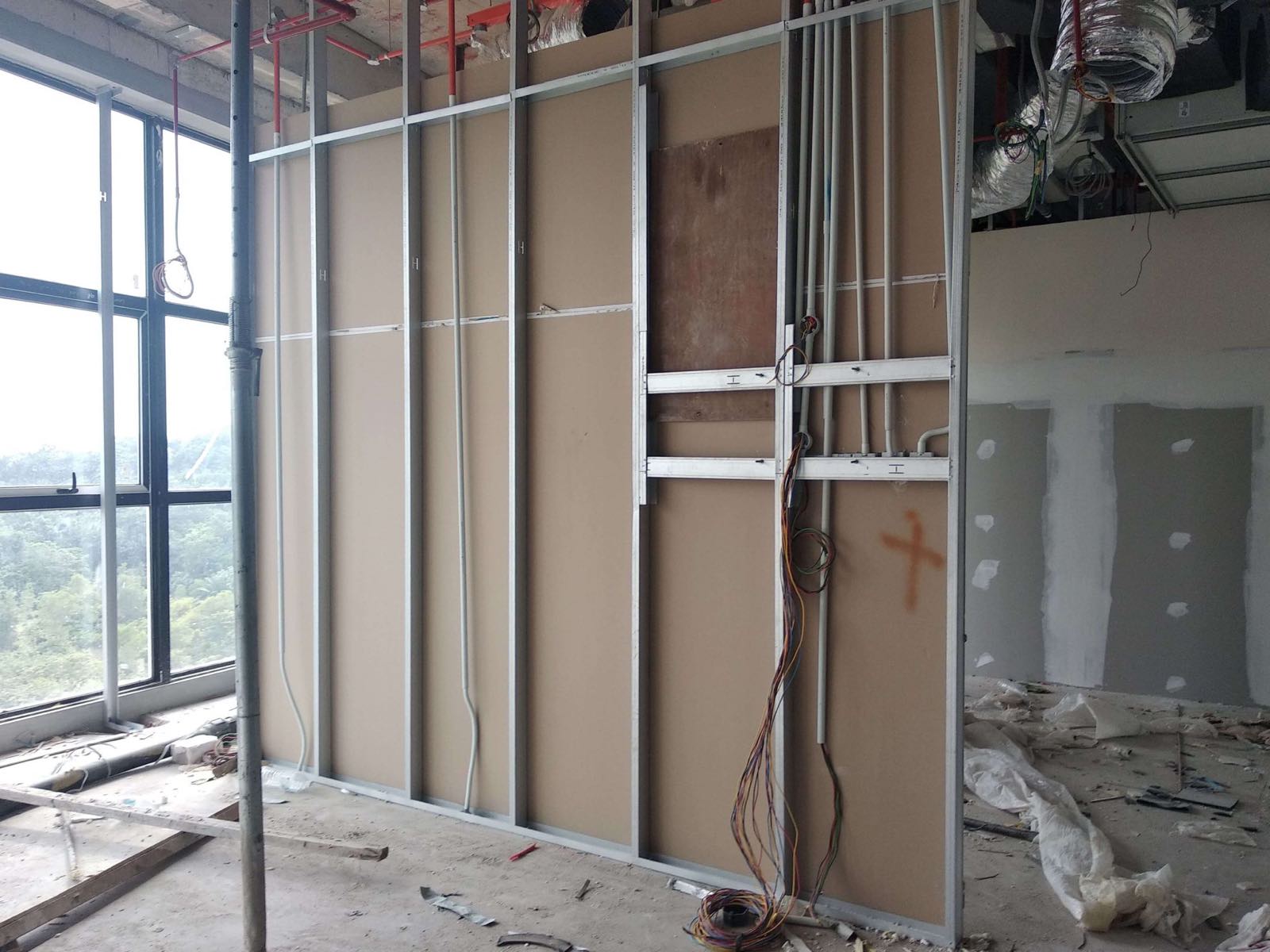
Our stud wall builders install partitions across London, from a single room division to 30- and 60-minute fire-rated and acoustic walls for HMO conversion. As one accountable contractor for landlords, letting agents and homeowners, we design layouts around the Building Regulations and minimum room sizes, reconfiguring properties so you gain compliant, lettable rooms — and rental yield — without cutting corners.
Written Guarantee: 10 Years
|
Average Timeline Range: 3 days - 3 weeks
Stud Partitions Built to Last
A partition wall looks simple and is routinely built badly: bouncy boards, cracking joints and doors that rattle in their frames within a season. We build in metal or timber stud to suit the situation — metal for speed, straightness and fire performance in flats and HMOs across Zones 1 and 2; timber where fixings, period skirtings and deep architraves in a Victorian or Edwardian terrace demand it.
Every partition is set out with door positions, switch and socket locations and any pipework agreed before the first track is fixed to the floor. Boards are screwed to proper centres — not the widely spaced pattern that gives that hollow drum-skin feel — joints taped and jointed or skimmed to a full plaster finish, and new electrics are run and certificated by our own BS 7671 electricians while the wall is still open. Skirtings, architraves and cornice are matched to the room so the wall reads as original fabric rather than an afterthought.
Because we work as one contractor, the plasterer, electrician and decorator are sequenced by a single project manager, so you are not left chasing three trades to finish one wall. The work carries our written 10-year guarantee.
Fire-Rated and Acoustic Partitions for HMOs
In an HMO, the wall between a bedroom and the escape route is part of the fire strategy, not just a divider. Licensing standards typically require 30 minutes of fire resistance (FD30), and conversions between commercial and residential uses can demand 60. We build fire-rated partitions with the correct boards, fixing centres and a fully sealed perimeter, because a fire wall with an unsealed top track is theatre, not protection — and it is exactly what a council HMO officer will pull apart on inspection.
Acoustic performance matters just as much to the people paying rent. Sharers leave over noise, and Approved Document E of the Building Regulations sets the benchmark for airborne sound between rooms used for sleeping. We build acoustic partitions with staggered or resilient-bar studs, mineral wool in the void and double boarding, and we are honest about what a lightweight wall can and cannot achieve before you spend a pound on it.
The two build-ups overlap, so a single wall can carry both an FD30 or FD60 rating and strong sound insulation together. It is thicker and costs more than a basic partition, which is why we agree the specification, in writing, before setting out — no surprises mid-job.
Reconfiguring Layouts for Rental Yield
The most profitable building work in a rental property is often not an extension but a better plan. Moving a partition can turn a wasted half-landing into storage, split an oversized through-reception into a compliant extra bedroom, or rescue a box room that falls just below the legal minimum. In London’s period and ex-local-authority stock, an extra lettable room frequently pays for the works inside a year.
The numbers are strict. Mandatory HMO conditions set 6.51 square metres as the minimum sleeping room for a single adult over ten and 10.22 square metres for two adults, with floor area under 1.5-metre ceiling height generally excluded — a real issue in loft rooms and under stairs. Habitable rooms also need adequate natural light and ventilation under the Building Regulations, so a windowless partitioned box is not a bedroom you can let.
We measure, draw the options and price each one — including the knock-on works of doors, electrics, heating and decoration — so you compare genuine totals rather than a headline wall price. Where building control approval is needed, we handle the application and the sign-off.
How to Choose the Right Partition for Your Project
Start with the job the wall has to do, because that dictates the build-up and the budget — not the other way round. If you simply want to form a study or a walk-in cupboard in your own home, a standard plasterboard stud is enough, and metre-rate pricing (around £90–£160 per m2) is fair. If the wall separates lettings or borders an escape route, you are into fire-rated territory and should never accept a standard-wall price for a fire job.
Decide metal versus timber next. Metal stud is faster, dead straight and predictable for fire performance, which suits flats, mansion blocks and HMOs. Timber earns its place in period rooms where you need solid fixings for heavy shelving, radiators or ornate skirtings and architraves. Then settle acoustics: if the wall divides bedrooms or borders a party wall, budget for the resilient-bar, mineral-wool, double-board upgrade — retro-fitting it later means opening the wall again.
Finally, weigh the three questions that catch people out in London: does the finished room meet minimum size and light rules; does a leasehold flat need a licence to alter; and does the work trigger building control. A contractor who raises these unprompted, in writing, is the one to trust — an itemised fixed quote that names the stud, boards, rating and making good beats a cheaper one-line figure every time.
Building Regulations, Party Walls and Leasehold Consent
A new partition is rarely just carpentry in the eyes of the law. Building control approval is commonly needed where the wall affects a fire escape route, creates a new habitable room that must satisfy ventilation, light and — in HMOs — minimum-size requirements, or has any structural implication such as loading a floor that was not designed for it. Simple cupboard-forming partitions usually do not need approval; we confirm exactly which applies at survey and handle the application where it does.
Leasehold flats add a layer. Most London leases require the freeholder’s consent — a licence to alter — before you change the internal layout, relocate services or alter flooring build-ups. Starting without it risks a demand to reinstate and problems at resale, so we prepare the drawings and schedules of condition these applications need and liaise with your managing agent while material lead times run in parallel.
Where a new or altered wall meets a wall shared with a neighbour, the Party Wall etc. Act 1996 can apply. We flag when notices are needed and work alongside your party wall surveyor, so the legal steps run beside our programme rather than delaying the start on site. We carry £5m public liability insurance that managing agents routinely ask to see.
Working Cleanly in Occupied and Tenanted Homes
Partition work is dusty, cutting-heavy and noisy, and most of ours happens in properties that are lived in — a family staying put while a study is formed, or an HMO where other rooms remain let throughout. How a contractor manages that mess and disruption is as telling as the finished wall.
We protect floors and route materials to avoid common parts where we can, dust-sheet and seal the work zone, and cut outside or with extraction to keep gypsum dust out of the rest of the home. In flats and mansion blocks we keep noisy works within the managing agent’s permitted hours — typically 9am to 5pm on weekdays — book lifts, and introduce ourselves to adjoining neighbours before we start, which is the single biggest factor in keeping porters and residents on side.
In tenanted HMOs we sequence room by room with proper written notice given through you or your agent, keep escape routes clear and alarms live at the end of every working day, and leave the site swept. Access and parking in boroughs with permit or red-route restrictions is planned in advance so a skip or delivery never becomes your problem or a PCN on the works account.
What Partition and Reconfiguration Work Costs in 2026
A standard plasterboard stud wall, built, skimmed and decorated, typically costs £1,000–£2,000 depending on length, height and whether it carries a door. On a rate basis that is roughly £90–£160 per square metre for a plain wall, before doors, electrics or heating moves. A fire-rated FD30 partition runs about £1,500–£3,000 per wall because of the certified boards, tighter fixing centres and sealed perimeter, and an acoustic upgrade adds £300–£800.
Reconfiguration is priced as a package rather than a single wall. Splitting one room into two — partition, a new doorset, electrics, a repositioned radiator and decoration to both spaces — commonly lands between £3,500 and £8,000. A full HMO layout conversion involving several fire and acoustic walls, certified doorsets and making good throughout a house typically falls between £8,000 and £30,000, driven by the number of rooms and the fire strategy.
Inner London and difficult access add 15–25% to labour, and we suggest a modest contingency for older properties where studs and services behind existing walls can surprise. Every figure here is a guide; your project is confirmed with a fixed written quote, itemised line by line, after a free survey — so you can adjust the specification and watch the total move before you commit.
What Partition Walls & Room Reconfiguration Costs in London (2026)
Item
Typical London Price
Notes
Standard plasterboard stud wall (built, skimmed, decorated)
£1,000–£2,000 per wall
Single room-height wall up to ~4m; making good both sides included
Metal or timber stud partition
£90–£160 per m2
Board, skim, tape-and-joint; excludes doors, electrics and heating moves
Fire-rated FD30 (30-minute) partition
£1,500–£3,000 per wall
Correct boards, sealed perimeter and fixing centres for HMO escape routes
Acoustic upgrade to a partition
£300–£800 per wall
Resilient or staggered studs, mineral wool and double boarding to Approved Document E
FD30 fire doorset (supply and fit)
£450–£850 per unit
Certified doorset with intumescent seals, closer and correct ironmongery
New internal stud doorway (frame, lining, door hung)
£350–£650 per unit
Includes architrave and decoration; standard non-fire door
Electrics into a new partition (socket, switch, light)
£220–£500 per wall
First and second fix by our BS 7671 electricians, certificated
Room reconfiguration — split one room into two
£3,500–£8,000 per property
Partition, doors, electrics, heating and decoration; building control if required
Full HMO layout conversion (partitions package)
£8,000–£30,000 per property
Multiple fire and acoustic walls, doorsets and making good across the house
Guide prices for Greater London in 2026, ex-VAT unless stated. Inner London and awkward access add 15–25%. Every job is confirmed with a fixed written quote after a free survey.
Insider Tips Before You Commit
Ask for the partition build-up in writing — stud type, board thickness and layers, insulation and fire rating — so you are comparing like for like, not just a length of wall.
In an HMO, insist the top track and perimeter of any fire wall are sealed; an unsealed fire partition offers little real protection and will fail an inspection.
Measure the resulting room before you commit — 6.51m2 is the mandatory single-occupier minimum, and floor area under a 1.5m ceiling generally does not count.
Choose metal stud for flats and HMOs where speed, straightness and fire performance matter; keep timber for period rooms with deep skirtings and heavy fixings.
Plan sockets, switches and radiator positions before boarding starts — chasing them in afterwards means fresh damage and a second decoration.
If your flat is leasehold, check whether moving a partition needs a licence to alter; many London leases require freeholder consent for any layout change.
For sharer retention, spend the extra on acoustic boarding to bedrooms — tenants leave over noise long before they leave over decor.
Get natural light and ventilation confirmed for any new bedroom; a windowless box created by a partition is not a habitable room under the Building Regulations.
How Not to Get Scammed
London has more rogue traders than any other UK market. These are the warning signs we see most often — and exactly what to do when you spot them.
Quotes a wall by the metre over the phone and won’t survey or put the build-up in writing.
Only accept a fixed written quote after a site visit that names the stud type, board layers and fire rating.
Sells a wall as ‘fire-rated’ but the price and spec match a standard single-board partition.
Ask which certified boards and fixing centres achieve FD30, and require photos of the sealed perimeter before it is skimmed.
Cash-only, no VAT invoice and a large deposit demanded before any work starts.
Pay against staged milestones on an itemised VAT invoice, and keep the deposit modest relative to materials on order.
Mid-job ‘we found more problems’ surprises that inflate the bill with no evidence.
Require photographs and a written variation before any extra is agreed; your fixed quote should already cover normal making good.
No proof of public liability insurance or electrical competence, yet happy to move sockets and lights.
Ask to see £5m public liability cover and BS 7671 certification, and insist on an electrical certificate for any new circuit.
Promises HMO room sizes will ‘be fine’ without measuring or mentioning building control.
Get the finished floor areas drawn and confirmed against your borough’s licensing standard, with sign-off where required.
Standards & Compliance
Every project is delivered to current British Standards and Building Regulations, with works documented for building control and HMO licensing sign-off — backed by fixed written quotes and a written guarantee.
BRITISH STANDARDS · BUILDING REGS COMPLIANT · FD30/FD60 FIRE DOORSETS · BS 5839-6 ALARMS · WRITTEN GUARANTEE
Frequently Asked Questions (FAQ)
How much does a stud partition wall cost in London?
A standard plasterboard stud wall built, skimmed and decorated typically costs £1,000–£2,000 depending on length, height and door provision, or roughly £90–£160 per square metre for a plain wall. Fire-rated 30-minute partitions run about £1,500–£3,000, and an acoustic specification adds £300–£800. Prices include making good both sides; electrics and heating alterations are itemised separately on a fixed written quote.
Do I need building regulations approval for a new partition?
Often yes. Approval is needed where the new wall affects a fire escape route, creates a new habitable room — which must meet ventilation, light and, in HMOs, minimum-size requirements — or has structural implications. Simple cupboard-forming partitions usually do not. We confirm exactly what applies at survey and handle the building control application and sign-off where it is required.
What is the minimum size for an HMO bedroom created by partitioning?
Mandatory HMO licensing conditions set 6.51 square metres for a single adult over ten and 10.22 square metres for two adults, with floor area under 1.5-metre ceiling height generally excluded. Some London boroughs apply larger standards through their own schemes. We design partition layouts so every resulting room clears the standard that applies to your property, with a margin rather than a knife-edge.
Can a partition wall be fire-rated and soundproof at the same time?
Yes — the build-ups overlap. A staggered or resilient-bar stud wall with mineral wool and double fire-rated boarding each side achieves 30–60 minutes of fire resistance and strong airborne sound insulation together. It is thicker and costs more than a basic wall, which is why we agree the specification in writing before setting out so there are no surprises when it is finished.
How long does it take to build a partition or reconfigure a room?
A single stud wall is usually built, skimmed, dried and decorated within 3 to 5 working days. Splitting a room with a new doorway, electrics and heating typically takes about a week, and a full HMO layout conversion involving several fire and acoustic walls runs up to 3 weeks. We issue a written programme before starting and flag any movement immediately rather than at the end.
Metal stud or timber stud — which is better?
It depends on the room. Metal stud is faster, dead straight and predictable for fire performance, which makes it our default in flats, mansion blocks and HMOs. Timber earns its place in period rooms where you need solid fixings for heavy shelving, radiators, or deep skirtings and architraves. We recommend one over the other at survey based on the wall’s job, not on which is cheaper to install.
Do I need my freeholder’s permission to move a partition in a leasehold flat?
Usually yes for a layout change. Most London leases require a licence to alter before you move internal walls, relocate services or change flooring build-ups. Starting without it risks a demand to reinstate and problems at resale. We prepare the drawings and schedules of condition the application needs and liaise with your managing agent, running the consent process alongside our material lead times.
Will the new wall crack or feel hollow later?
Not when it is built properly. The hollow, bouncy feel and cracked joints come from boards fixed to widely spaced or under-supported studs. We set studs to correct centres, use proper noggins, and tape-and-joint or full-skim the surface so it behaves like solid plaster. Every partition we build carries our written 10-year guarantee, so if a defect in our workmanship appears, we put it right.
Can you work while my HMO is still tenanted?
Yes — most of our partition and reconfiguration work is in occupied homes and part-let HMOs. We give proper written notice through you or your agent, seal and dust-sheet the work zone, work room by room, and keep escape routes clear and alarms live at the end of every working day. Noisy works stay within the managing agent’s permitted hours in flats and blocks.
Why use one contractor instead of hiring a carpenter and electrician separately?
A partition touches several trades — stud and boarding, plastering, electrics and decoration — and the joins between them are where jobs go wrong and blame gets passed around. As one accountable contractor we sequence every trade under a single project manager, certificate the electrics ourselves, and stand behind the whole wall with one written guarantee and one fixed quote, so you are never left coordinating three firms to finish one room.
Our Written Guarantee
We provide a fully comprehensive, written 10-Year guarantee covering all structural reinstatement, moisture boundaries, and finish coatings.
100% Insurance Protected
Request an Elite Assessment
Secure a rapid, high-precision physical survey by our team. Fill out our briefing engine instantly.
Partition Walls & Room Reconfiguration Across Greater London
We deliver partition walls & room reconfiguration across all 33 London boroughs — from the City and Central London out to the M25. Tap any marker to see coverage and local postcodes.